Why Inventory Is One of Fashion’s Biggest Financial Risks
In fashion, it often behaves more like trapped cash and future markdowns. The problem is rarely the inventory itself - it’s the system that forces brands to hold it.
Sophia Chu
Last updated on 3/16/2026
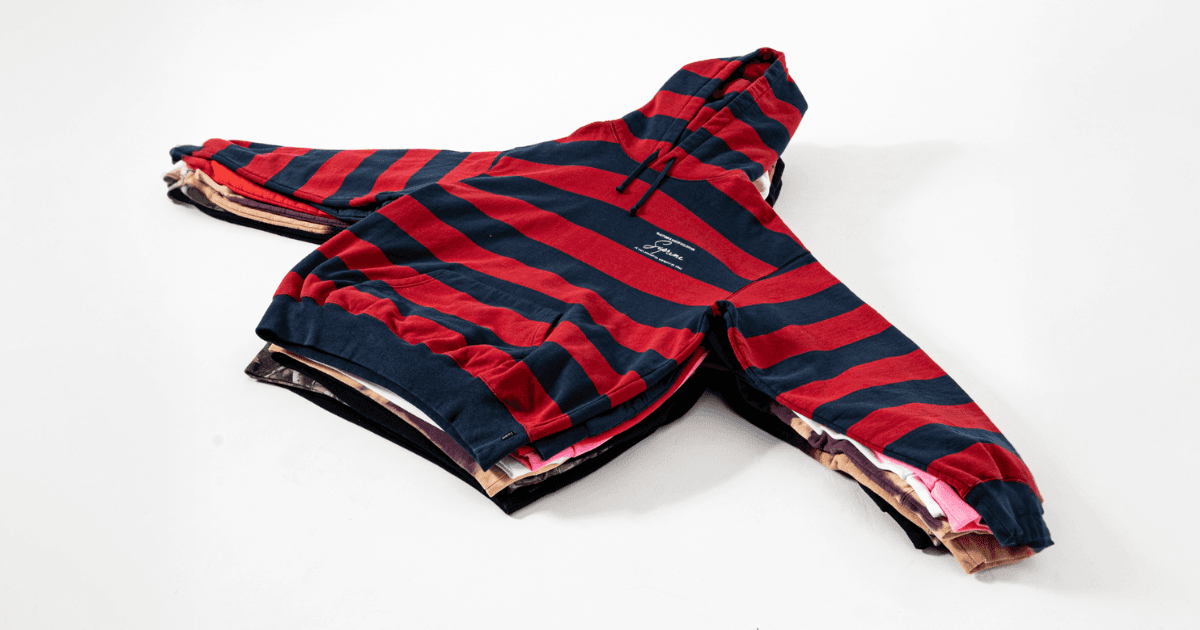
Sweatshirt blue
Starting with the paradox: inventory appears as an asset on a balance sheet.
In fashion, it often behaves more like trapped cash and future markdowns. Brands frequently commit millions to products months before a single item reaches the customer. By the time those garments arrive in stores, demand has already shifted.
The problem is rarely the inventory itself.
It’s the system that forces brands to hold it.
Inventory is capital sitting still
The most immediate operational cost of low durability is the workload it creates. A product that fails early creates a ripple effect that travels backward up the supply chain.
Low durability forces sourcing teams to manage failure rather than flow. Every defective unit or premature wear-out triggers a series of unplanned tasks: issuing replacement purchase orders, revisiting tech packs and specifications, coordinating expedited freight, and handling the internal approvals required to correct gaps in inventory.
Brands often underestimate this overhead. There is a tangible cost to managing the complexity of fixing bad products. When you source for durability, you are effectively buying stability. You are reducing the frantic cadence of replacing inventory that should have remained sellable.
The Fallacy of Replacement Volume
Beyond the administrative workload, there is a strategic error in how we view volume. Churn is often rationalised with a familiar assumption: that if a product wears out quickly, the customer will simply come back for another unit, driving up sales volume.
From a supply-chain perspective, this is a "fragile bet." It assumes that replacement demand behaves like healthy replenishment demand. In reality, product failure is more likely to break the demand signal entirely. In a saturated market, poor durability rarely triggers a reorder; it triggers a switch.
This switch creates "bad complexity." Instead of generating profitable outbound flow, we generate costly reverse logistics. We end up processing returns, managing write-offs, and clogging the warehouse with defective stock, all of which looks like "activity" but is actually a financial leak. Durable products stabilise the supply chain because they keep the movement of goods predominantly outward, rather than constantly looping back through returns and replacements.
Forecasting in a Volatile System
One of the less visible costs of low durability is the instability it introduces into forecasting. When products fail early, demand signals become harder to read. Replacement orders, short-cycle reorders, and corrective shipments begin to sit alongside genuine consumption, blurring the line between real demand and operational correction.
This makes planning more brittle. Forecasts are no longer built solely on sell-through, but on a mix of sales, replacements, and recovery actions. Small quality issues can trigger disproportionate swings in inventory movement, forcing teams to adjust plans frequently and under time pressure.
Durability changes the mathematics of planning by widening the margin for error. When products perform consistently, demand data remains cleaner and replenishment cycles stabilise. Forecasts can be set over longer horizons without being repeatedly overridden by corrective volume.
From a sourcing management perspective, this stability enables better decisions upstream. Capacity can be secured earlier, production schedules become more predictable, and teams avoid the rush fees and premiums that arise when volatility forces last-minute intervention. When brands experience chronic capacity constraints or delayed shipments, the root cause is often not external disruption, but the cumulative effect of product-level volatility feeding back into the planning system.
Complexity vs. Simplicity
There is a prevailing myth that durability is "harder" to source. It requires better materials, tighter tolerances, and more vetted suppliers. While true during the development phase, at a systems level, durability actually drives simplicity.
Low-quality production thrives on complexity. It relies on a sprawling network of sub-suppliers, rapid-fire sampling rounds to fix cutting corners, and a vast inventory of SKUs to maintain novelty. In contrast, a focus on durability usually leads to consolidation. You stop chasing the cheapest needle in the haystack and start building deep, repeating programs with manufacturers who can execute a standard consistently.
Operational friction decreases when you stop fighting the product. We have all seen the scramble that happens when a "cheap" fabric fails a late-stage lab test, or when a bulk shipment arrives with a 5% higher defect rate than anticipated because the inputs were value-engineered to the breaking point. That friction costs time, money, and political capital within an organisation. A robust product flows through the chain; a fragile one drags.
The Changing Role of the Supply Partner
As sourcing partners, the ask from brands is shifting. Ten years ago, the primary demand was agility, how fast can we find a factory, and how fast can they ship? Today, the smartest brands are asking us to solve for longevity. They realize that their operational expenses (OpEx) are being eaten alive by the consequences of poor quality.
We are no longer just finding factories; we are risk mitigators. When a sourcing director asks, "How can we make this cheaper?", the honest answer is often, "By making it better." By investing in a construction that minimizes returns and maximizes sell-through, the total cost of ownership drops, even if the FOB price ticks up.
This requires a level of trust that transactional sourcing doesn't allow. It means viewing the sourcing partner not just as an order-taker or a buffer between the brand and the factory, but as a strategic architect. The brands winning right now are the ones discussing fiber lengths and seam integrity not just for marketing copy, but for supply chain efficiency.
Conclusion: The Cost of Consequences
We need to stop looking at sourcing as a linear race to the bottom price. The supply chain is a loop, and low durability acts as a leak in that loop. It drains resources, clouds visibility, and creates unnecessary work for everyone from the fabric mill to the demand planner.
Sourcing for longevity is not just an altruistic "sustainability" play. It is a hard-nosed operational strategy. It cleans up the spreadsheet by removing the hidden lines of code related to waste, returns, and administrative churn.
The brands that will thrive in the next decade are those that understand that the cheapest product is the one you only have to make once.
Share this post